The Hermit and the Concubine (Norman Costa)
My cousin, Louis Defilippi, is a biochemist and lives in Chicago. When he is not tinkering with peptide chains he is the resident geneologist for the Costa family. On his Facebook page, Louis dedicated this Fathers Day to our great, great, great, great, great, great, great, great, great, great grandfather Honofrio La Mantia, born in Sicily around 1566, and named after the Greek Egyptian saint, "Onuphrius or Onoufrios (Greek: Ὀνούφριος, from Egyptian: Wnn-nfr meaning "he-who-is-continuingly-good")."
Louis included a link to an icon art piece of Saint Onoufrios (I prefer the Greek.) The Saint was revered in the Roman Catholic Church, and Eastern Othodox, Oriental Orthodox, and Eastern Catholic Churches. The icon depicts Onoufrios as he was known to live his life, as a revered desert hermit. His life is interesting and curious in the way most stories about 4th century desert hermits are interesting and curious to us who are removed by many centuries.
I found the icon, itself, fascinating. The resolution of the art work is sufficient to examine and enjoy the detailed work of the artist. The provenance and date of the icon are unknown. You can see it in full resolution HERE. It shows an old hermit dressed only in his long hair and a loincloth made of leaves. I did say he was a desert hermit. You can see an angel bringing him the Eucharist, the sacramental bread that becomes the Body of Christ.
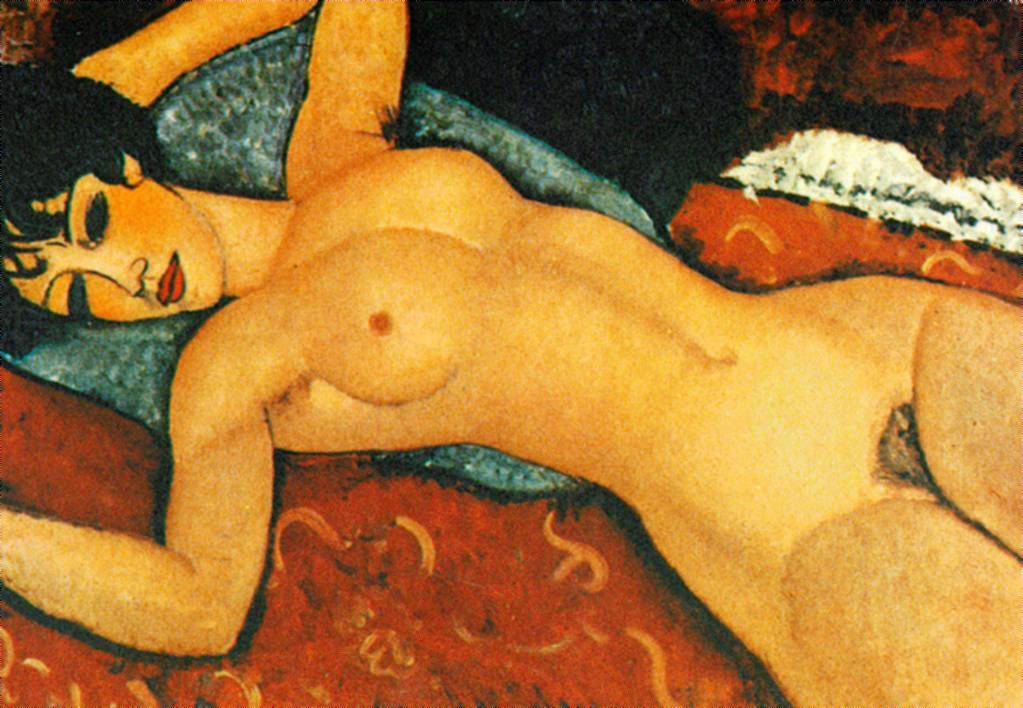
A couple of things fascinate me about the painting, starting with color. I love the gold that is both deep and bright. Light shines with a white-out on his beard. The reds have a deep blood feel to them. The green of trees and loincloth leaves are like the German Schwarzwald. Most interesting, though, is the strange depiction of the body form. That is what brings me to the Grand Odalisque of Jean Auguste Dominique Ingres (1814.) The oil on canvas is in the Louvre, in Paris.
The body of the the beautiful concubine is not anatomically correct. That's the point. We see what the artist saw, or at least what he tried to depict. For reasons aesthetic, geometric, sensual, and many more it is one of my favorites.
The Onoufrios icon is the same in that the body form is not anatomically correct. However, something very different is going on here. The Odalisque's head and face are recognized as those of a real human being and beautiful at that. Onoufrios has a head and face recognizable as mostly like a real person, but with the sense of a caricature. This is not a clownish caricature, but a deeply chiseled look of a desert hermit who is not of this world. Except for the wings, the angels have the more authentic looking human forms.
Let's get to the rest of Onoufrio, from the chin down. Where did that body come from? I won't put words to describing it. You can look for yourself. What was he or she thinking? Perhaps the master artist did the face and halo and sketched out the overall design. Maybe an apprentice finished it, quickly, with a not-too-careful attention to anatomical detail so they could deliver it, get paid, and move on to the next commission.
I have a different theory. The head of the Saint, the angels, the religious symbolism, and the landscape elements were for the benefactor who footed the bill, and for the priest-inspectors who looked for anything unholy or not according to the rules of religious art. The rest, the strange body form, was for the artist. This was his chance to experiment or develop his own view of nature. This is the way he would show his stuff if he had the chance. Well, he had the chance. If it is not great art, it is still very interesting to the point that you would have liked to watch him in his (maybe her) studio, then take him to lunch and let him talk about his work.
There is one detail I would like to point out. Look at the Saint's right foot and the way the toes are depicted. Did we have a budding Picasso long before the real one?
 Accidental Blogger


Leave a reply to Ruchira Cancel reply